The Future of Apps: Everything You Need to Know About Progressive Web Apps (PWAs)
The mobile revolution has reached a point of saturation, giving way to a phenomenon known as "app fatigue." Users are no longer eager to browse cluttered app stores, manage constant updates, or sacrifice precious device storage for services they may only use occasionally. This friction has created a strategic opening for Progressive Web Apps (PWAs)—a transformative technology that dismantles the "walled garden" model of traditional app distribution.
4/29/20264 min read
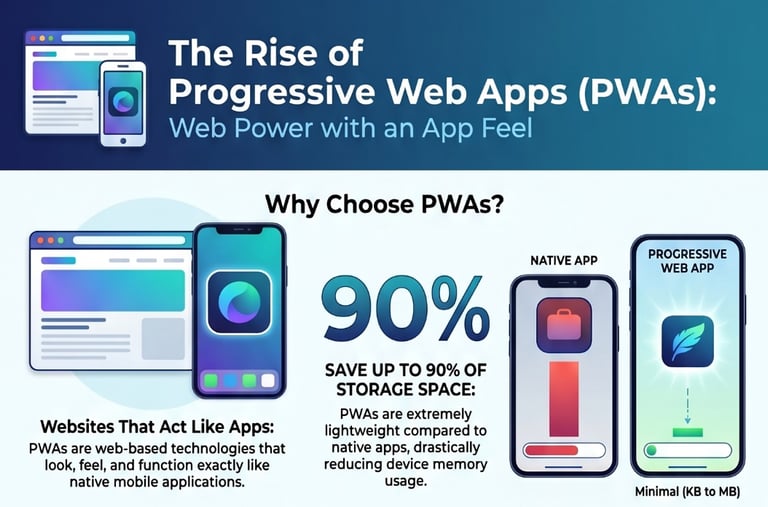
At its heart, the PWA represents the ultimate "solution," a concept encapsulated by the Swahili word Ufumbuzi. By eliminating the barriers of limited storage and sluggish data connections, PWAs provide a frictionless path to digital engagement. They are, quite literally, the evolution of the web: sites that have evolved to deliver the performance, look, and feel of a native application without the overhead.
Deciphering the PWA: The Hybrid Revolution
The strategic value of a PWA lies in its ability to bridge the gap between the universal reach of the web and the high-fidelity experience of native software. By using standard languages like HTML, CSS, and JavaScript, businesses can maintain a single codebase that serves every device, effectively ending the era of costly, platform-specific development.
The PWA experience is defined by four pillars:
Progressive: They are built to work for every user, regardless of browser choice, scaling their capabilities based on the device’s power.
Installable: They reside on the home screen without an app store middleman, launching in full-screen mode with their own icon.
Connectivity Independent: They function on spotty 2G/3G networks or even entirely offline.
Responsive: They adapt seamlessly to smartphones, tablets, or desktops.
This "app-like" behavior is powered by a sophisticated core architecture:
The Service Worker: Imagine a smart personal assistant living in your browser. This script runs in the background, intercepting network requests to serve cached content instantly or handling push notifications even when the browser is closed.
The App Manifest: This is the app’s "identity card"—a JSON file that tells the operating system how the app should look, which icons to use, and how to hide the browser address bar to create an immersive experience.
The App Shell: Think of this as a "permanent storefront." The app shell caches the structural skeleton of the interface so it loads instantly upon opening, while the "inventory" (the dynamic content) is fetched in the background.
PWA vs. Native Apps: A Strategic Comparative Breakdown
For the modern enterprise, the choice between Native and PWA is a balance of performance versus reach. While native apps still hold an edge in high-intensity processing, PWAs have closed the gap significantly, now offering access to advanced APIs like biometric readers and GPS.
Crucially, PWAs offer a massive SEO advantage. Unlike native apps, which are "invisible" to search engines, PWAs are fully indexable. This means your "app" is discoverable via a simple Google search, a strategic lever that native apps simply cannot pull.
Fully Search Engine Optimized (SEO)
The "Friction Factor" is the true killer of user retention. Every step required to access a service—searching a store, authenticating a password, waiting for a download—is a moment where a user might quit. By moving from a "Download" model to a "Direct Access" model, PWAs drastically slash abandonment rates.
The End of the Megabyte Tax: Key Benefits for the User
PWAs are the strategic choice for a world where device storage and data are at a premium. They optimize the digital lifestyle by removing the "bloat" of traditional software.
Ultra-lightweight footprint: While a native app might demand 50MB, the Uber PWA consumes just 50KB. This 90% reduction in storage allows users to keep an entire suite of tools on their phone without ever seeing a "Storage Full" alert.
Data Efficiency: PWAs are lean by design. By only fetching necessary data and using intelligent caching, they are a lifeline for users in areas with expensive data plans or weak connectivity.
Security & Privacy: PWAs are "secure by default" because they require HTTPS to function. Furthermore, they run in the browser’s "sandbox," which provides a robust layer of protection against unauthorized access to your system files compared to the deeper permissions often required by native apps.
Instant Updates: You will never have to visit an app store to "Update All" again. PWAs refresh themselves in the background, ensuring you are always using the most secure, feature-rich version.
The One-Click Install: A Storeless Experience
The strategic shift here is moving from "Downloading" a heavy file to simply "Adding" a link that behaves like an app.
Android (Chrome): Open the site, tap the three-dot menu, and select "Add to Home Screen."
iOS (Safari): Open the site, tap the 'Share' button (square with arrow), and select "Add to Home Screen." (Note: Apple currently restricts this functionality to Safari).
Desktop (Chrome/Edge): Look for the small "+" icon in the address bar, often explicitly labeled "Install [App Name]." Once clicked, the site launches in its own dedicated window on your PC or Mac.
Find free PWAs at 👉 https://ufumbuzi.com
The Fine Print: The Apple Bottleneck and the Road Ahead
Despite their rise, PWAs face a significant hurdle: the "Apple Bottleneck." While Safari (v16.4+) has improved, Apple continues to limit background sync and push notifications. This isn't just a technical oversight; it is a calculated business move. Apple has billions of dollars in revenue at stake via App Store commissions and electronic payment processing. By "bottlenecking" the open web, they protect their 30% "slice" of the native app economy.
Furthermore, if your project requires intensive AR/VR rendering or heavy video editing, native apps remain the gold standard. However, for 90% of business and consumer needs, the PWA is catching up. The market reflects this shift: valued at 3.86 billion in 2024, the global PWA market is projected to skyrocket to 21.76 billion by 2033.
Final Verdict: Is it Time to Ditch the App Store?
Progressive Web Apps are the definitive answer to the complexities of the modern mobile era. They offer the speed and engagement of native software with the reach and lightweight nature of the web. For the vast majority of our digital lives—from ordering coffee to managing complex text editing—the PWA is the superior, frictionless choice.
Quick-Start Summary:
Visit the website of your favorite service.
Look for the "Add to Home Screen" or "Install" prompt.
Enjoy 90% more storage, faster speeds, and total data privacy.
The PWA is the universal solution for a connected world. It returns the power to the user, removes the "tax" of the app stores, and creates a seamless bridge between a service and the person who needs it.