FIFA World Cup 2026: The Most Data-Driven Edition in Football History
The FIFA World Cup 2026, to be hosted across the United States, Canada, and Mexico from June 11 to July 19, will not only be the largest in scale—featuring 48 teams and 104 matches—but is set to become the most advanced technological laboratory in the sports industry. Building on the success of Qatar 2022, the 2026 edition seeks to redefine how football is studied, consumed, and officiated through the massive use of Artificial Intelligence (AI) and real-time data processing.
5/25/20263 min read
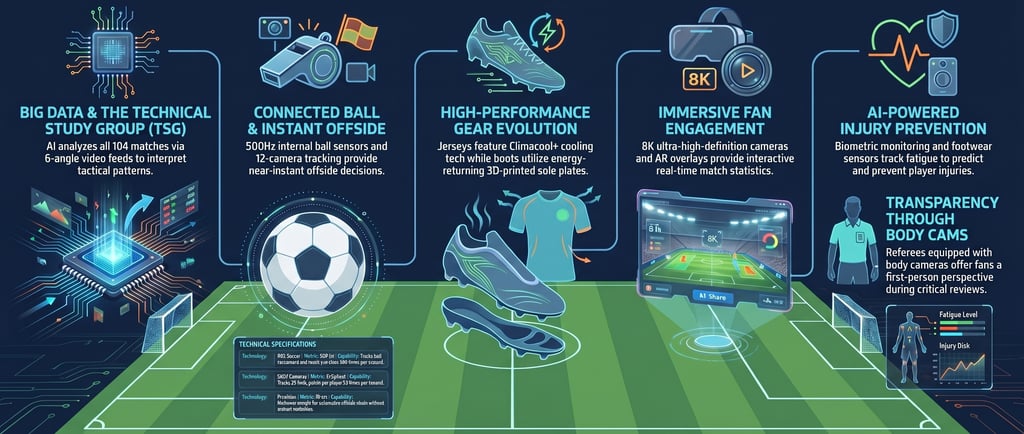
1. The Technical Study Group (TSG) and Tactical Big Data
Under the supervision of the legendary Arsène Wenger, FIFA has deployed an unprecedented analysis infrastructure. An international team of specialists, including figures like Jürgen Klinsmann, Gilberto Silva, and Pablo Zabaleta, will process every match from strategic tech hubs in Miami, Dallas, and Manchester.
Multidimensional Analysis: The technological platform will capture thousands of data points live, utilizing up to six simultaneous video angles to interpret not just individual movements, but collective patterns such as tactical pressure and space occupation.
Data Democratization: For the first time, fans will have access to technical analysis and advanced metrics in real-time through digital platforms and social media, information that was previously exclusive to professionals.
2. Refereeing 2.0: Instant Offside and High Precision
Refereeing technology is evolving significantly from the systems seen in 2022. The main innovation is the implementation of an enhanced semi-automated offside system.
Millisecond Decisions: The system utilizes high-speed cameras and 500 Hz inertial sensors integrated into the ball to track specific body points on every player. This allows for the generation of automated 3D animations that show the exact position of players at the moment of a pass.
Transparency: Television broadcasts will incorporate advanced graphics and augmented reality tools to explain key decisions, bringing professional-grade analysis closer to the general spectator.
3. Viewing Experience: 8K and Total Immersion
The transmission of the 104 matches will integrate cutting-edge technologies to enrich the visual narrative.
Ultra-High Definition Broadcasting: The use of 8K cameras will provide extreme clarity, while Augmented Reality (AR) will overlay tactical data on the live image to enhance the viewer's experience.
Interactivity: Fans will enjoy replays from multiple angles and real-time statistics, transforming passive viewing into an interactive experience.
4. High-Performance Equipment: Climacool+ and Smart Footwear
Innovation also reaches the hardware worn by athletes on the pitch.
The Return of Climacool+: Adidas is reviving its iconic brand by launching Climacool+ technology for the 2026 authentic jerseys, optimized for maximum cooling and performance in extreme conditions.
Next-Gen Boots: The tournament will feature boots designed using 3D printing to maximize energy return. Furthermore, footwear will increasingly integrate recycled materials (recovered polymers and foams) as part of new industry sustainability standards.
5. Injury Prevention: The Invisible Guardian
One of the most critical applications of Big Data in 2026 will be the protection of player health.
Real-Time Biometric Monitoring: Analyzing biometric data allows physical trainers to monitor variables such as heart rate, speed, and fatigue in real-time, adjusting workloads to minimize injury risks.
Predictive AI: Using Machine Learning algorithms, it is possible to identify biomechanical movement patterns that predispose athletes to injuries, allowing for preventive interventions before damage occurs.
Sensors in Footwear: Modern boots can now include smart sensors that record accelerations and movement loads, helping coaches quantify an athlete's accumulated fatigue.
The concept of "Injury Prevention: The Invisible Guardian" refers to the proactive use of Big Data and real-time analysis to safeguard athlete health during the 2026 World Cup. This technological pillar acts as a constant supervisor through several key mechanisms:
1. Real-Time Biometric Monitoring
Advanced sensors integrated into player equipment and wearable tech allow physical trainers to monitor critical variables such as heart rate, speed, acceleration, and fatigue levels during both training and matches. By analyzing this data, coaching staffs can make immediate adjustments to workloads, maximizing performance while minimizing the risk of overexertion that often leads to muscle or joint injuries.
2. Predictive AI and Machine Learning
Algorithmic analysis of an athlete's historical and current data allows for predicting injuries before they occur. These tools identify specific biomechanical or movement patterns that predispose a player to physical damage. Institutions specialized in sports engineering are increasingly focusing on these research areas to create a healthier competitive environment.
3. Smart Footwear Sensors
Next-generation football boots used in 2026 feature smart sensors that record metrics like shot force, point of contact, and movement loads. This data is essential for coaches to quantify accumulated fatigue for each player, enabling the design of personalized training sessions that prevent athlete burnout. While innovations like carbon plates improve sprint efficiency, the system monitors the player's biomechanical adaptation to ensure these hardware changes do not harm the body's physical structure.
Objective Rehabilitation and Safe Return
Beyond prevention, continuous physical tracking facilitates more effective rehabilitation. Advanced software for spatial analysis and movement tracking allows medical teams to monitor recovery objectively. This ensures that a footballer returns to elite competition only when their body is truly prepared, significantly reducing the chance of relapses
Conclusion: The Digital Football Blueprint
The 2026 World Cup is not just a tournament; it is the beginning of a new era where AI, integrated sensors, and massive data processing work in tandem to make the game smarter, faster, fairer, and, above all, safer for its protagonists